


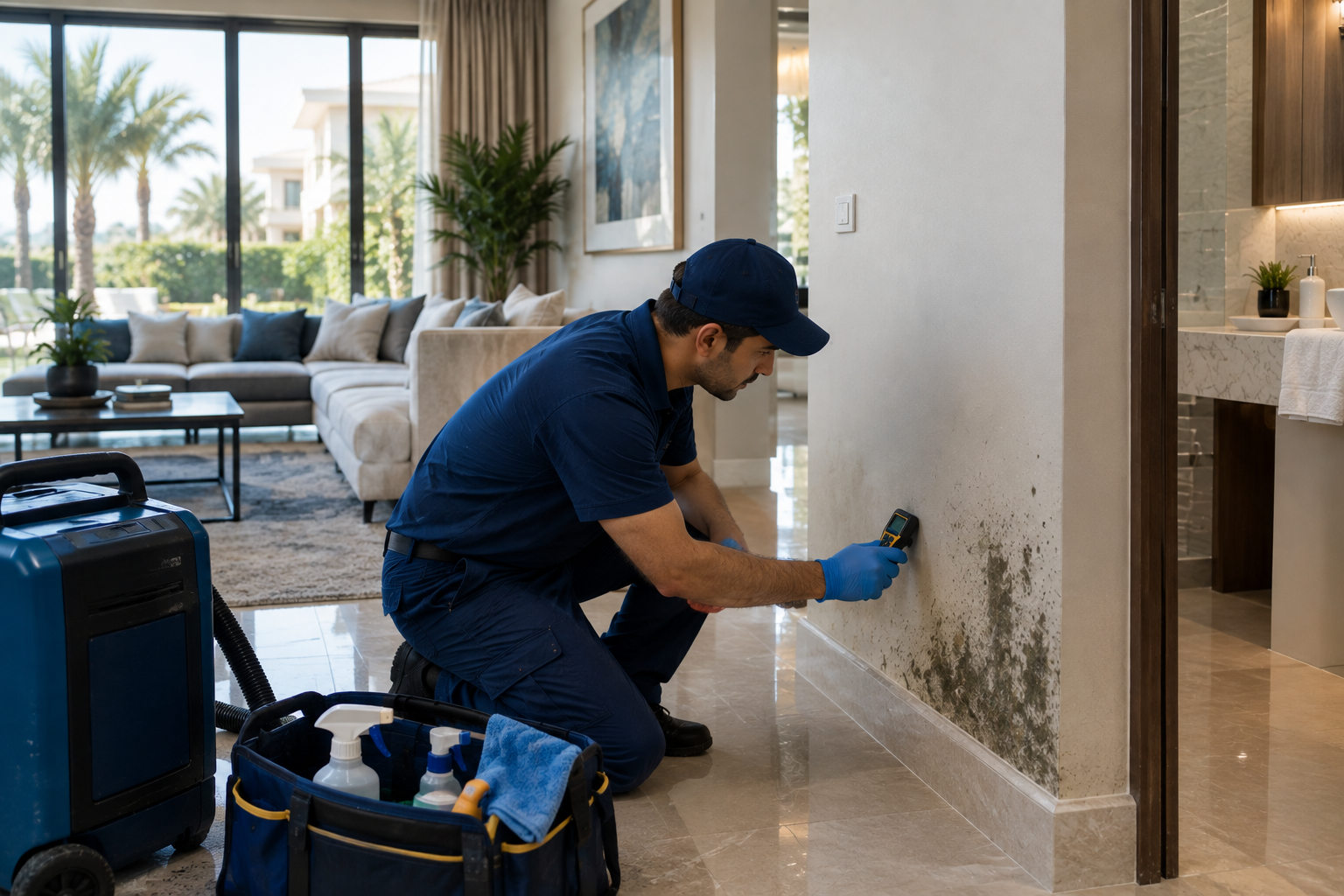

Protecting a villa in Dubai from mold requires managing indoor humidity long before damp odors or visible wall spots ever appear. In the UAE’s coastal desert climate, high ambient moisture combined with continuous air conditioning creates prime conditions for fungal growth. When indoor relative humidity climbs above 60%, airborne spores quickly settle inside AC ductwork, ceiling voids, and soft furnishings.
This authoritative guide outlines how to stabilize your home’s microclimate, optimize HVAC airflow, and eliminate hidden moisture sources to keep your villa completely mold free year round.
Eradicating deep seated damp odors requires looking beyond superficial fixes to control the building physics and moisture dynamics that allow microbial life to take root. This authoritative guide breaks down the precise protocols needed to stabilize indoor relative humidity within safe biological thresholds, neutralize condensation across vulnerable thermal cold bridges such as architectural window mullions, slab perimeters, and AC supply plenums and physically eradicate mold at its cellular substrate. By addressing the root cause of moisture mechanics rather than masking the symptoms, you can permanently safeguard your home’s structural integrity and restore true respiratory purity to your living environment.
Understanding Humidity and Mold Growth in Dubai Villas

Mold requires only two conditions to establish itself, a moisture source and an organic surface to feed on, both of which Dubai's climate supplies in abundance for large parts of the year, as the EPA's guidance on mold and moisture confirms applies to any warm, humid environment regardless of region.
The Safe Humidity Range
Indoor relative humidity should stay between 45% and 55% to inhibit mold growth effectively, with readings above 60% creating meaningful risk once sustained for more than a day or two. A digital hygrometer placed in bathrooms, kitchens, and any room that regularly feels stuffy or smells musty gives an early warning well before visible mold appears.
Cold Bridges and Condensation Points
Condensation forms wherever warm, moisture-laden air meets a cold surface, and in Dubai villas this happens most often at window edges, slab junctions, and any point where AC cooled interior air contacts a poorly insulated exterior wall. These "cold bridge" points collect moisture invisibly behind furniture or curtains long before a homeowner notices anything on the visible surface.
Furniture Placement and Airflow
Furniture pushed flush against exterior walls blocks the air circulation that would otherwise prevent moisture from settling, creating a microclimate behind the piece that stays damp far longer than the rest of the room. Leaving a small air gap between furniture and exterior walls, particularly in ground-floor rooms, allows this trapped moisture to dissipate before it becomes a problem.
How Your AC System Contributes to Mold Growth
Climate control is the primary defense against Dubai's punishing humidity, yet the very mechanism engineered to combat moisture frequently becomes its most efficient breeding apparatus once neglected, a paradox few homeowners recognize until a musty odor begins circulating through every vent in the villa.
Evaporator Coils and Drain Pans
Every cooling cycle extracts ambient moisture from the air, channeling condensation across the evaporator coil and into a drainage pan designed to carry it safely away. When airborne dust particles bind with this perpetual condensation, it forms a nutrient-dense biofilm, an ideal substrate for mold and mildew colonization directly within the mechanical core of the unit. This is precisely why AC-sourced odors persist stubbornly even after every visible surface in the villa has been immaculately restored, the contamination originates at the mechanical source, not the room itself.
Professional AC Cleaning Intervals
Filters demand monthly attention at minimum, while the coils, ductwork, and drain pan assembly require certified professional sterilization roughly every two to three years, sooner in villas with intensive daily use, a service a reputable villa cleaning company typically includes as part of a full deep clean.
How to Remove Mold from a Villa Safely
Prevention only helps once mold hasn't yet taken hold, if it's already visible, the approach shifts from humidity management to direct removal, and treating it incorrectly can spread spores rather than eliminate them.
Small, Surface-Level Mold
Mold confined to a small area on tile, grout, or non-porous surfaces can typically be treated with a mold-specific solution applied with proper ventilation. In high-moisture wet zones, following our guide on how to deep clean a villa kitchen and bathroom ensures you descale tiles, remove mineral build-up, and sanitize grout before spores spread into surrounding rooms.
Mold on Porous or Fabric Surfaces
Mold that has penetrated fabric, drywall, or other porous materials generally can't be fully removed with surface cleaning, since the growth extends beneath what's visible, and the affected material typically needs to be professionally treated or, in severe cases, replaced entirely rather than cleaned.
Eliminating Musty Odors at the Source
A musty smell is never something to be masked, it's a direct signal that mold or mildew has already colonized an absorbent surface somewhere in the villa, and fragrance treatments only conceal an active colony that continues expanding beneath the scent.
Identifying Where the Smell Originates
Musty odors concentrate most heavily near their source, so tracing the smell to a specific room or fixture, rather than treating the whole villa uniformly, narrows down whether the culprit is bathroom grout, AC ductwork, upholstery, or a damp corner behind furniture.
Treating Fabric and Soft Surfaces
Carpets, curtains, and upholstery absorb ambient moisture and musty odors far more readily than hard surfaces. Once mildew takes hold within the weave, surface deodorizers do nothing. Our detailed guide on how to clean villa windows and soft furnishings explains the low-moisture extraction and fabric-safe steam methods needed to sanitize delicate drapery and upholstery without trapping residual dampness.
Neutralizing Odor in AC Ductwork
When musty smell is traced back to the AC system itself, disinfecting the coils and drain pan directly addresses the source, while activated carbon or HEPA-grade filters help neutralize residual odor particles circulating through the ducts in the meantime.
Closing Paragraph
Humidity, condensation, and neglected AC systems all lead to the same outcome if left unaddressed, an environment where mold doesn't just become possible but becomes inevitable given enough time. Keeping indoor humidity within a safe range, allowing airflow around furniture at cold-bridge points, and treating musty odors as a source problem rather than a fragrance problem is what actually keeps a villa mold-free, rather than temporarily masking a problem that continues growing regardless.
FAQs
What humidity level causes mold in a Dubai villa?
Indoor humidity above 60%, sustained for more than a day or two, creates meaningful mold risk. Keeping levels between 45% and 55% effectively inhibits growth.
Why does my villa smell musty even after cleaning?
The odor's source likely hasn't been addressed directly, mold or mildew may be colonizing AC ductwork, carpets, or a damp corner behind furniture rather than sitting on a visible surface that cleaning would reach.
Can furniture placement really cause mold?
Yes. Furniture pushed flush against exterior walls blocks air circulation, creating a trapped, damp microclimate behind the piece where condensation and mold can develop unnoticed.
How often should AC coils and drain pans be professionally cleaned?
Roughly every two to three years for standard use, though villas with heavier daily AC use may need professional cleaning more frequently to prevent microbial buildup.
Is it safe to use a deodorizer on a musty smell instead of treating the source?
No. A deodorizer masks the smell temporarily while the underlying mold or mildew colony continues to grow, the source itself needs direct treatment or removal to actually resolve the problem.
Does Dubai's climate make mold more likely than in other regions?
Yes. Sustained high humidity for large parts of the year, combined with heavy AC use, creates conditions that require more active humidity and moisture management than drier or more temperate climates typically demand.